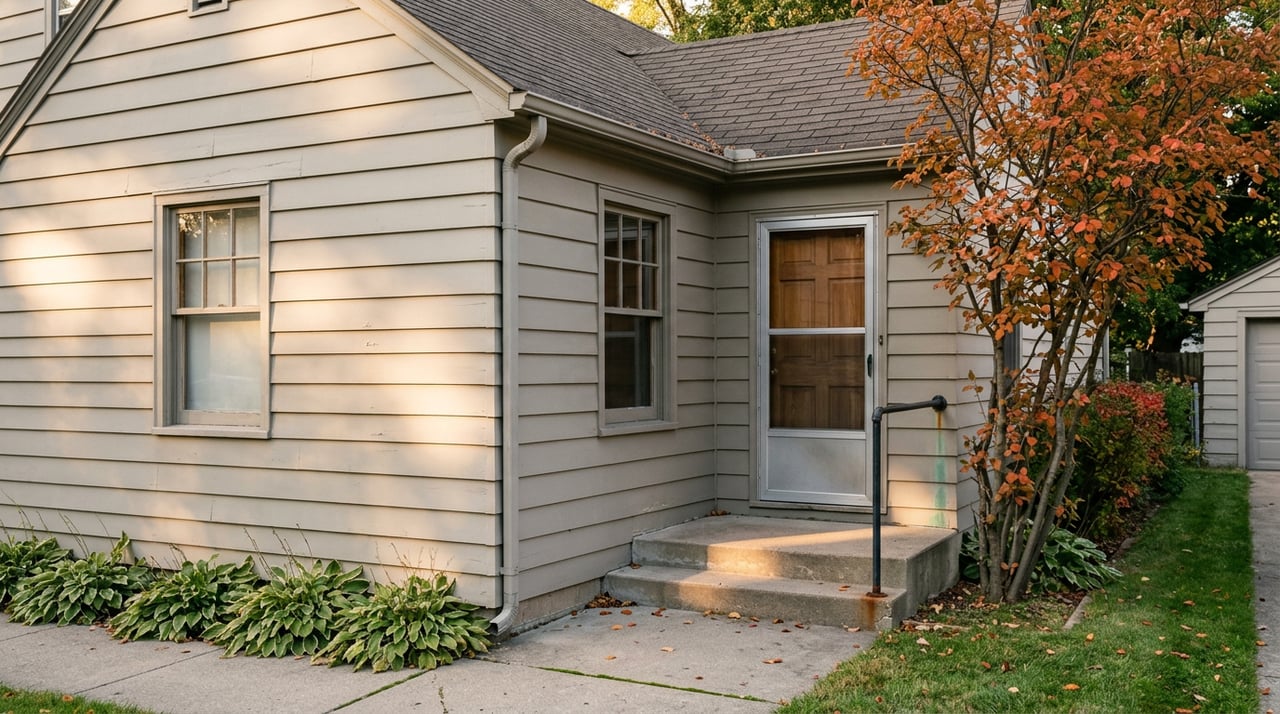
A seller in Bay View can complete Wisconsin's Real Estate Condition Report line by line, disclose the lead paint on record for a home built in 1910, hand over the EPA pamphlet, and still say nothing about the pipe that carries water from the street into the kitchen. That is not an oversight on the seller's part. The form was never built to ask the question.
For buyers and sellers in a neighborhood built mostly before 1950, that gap matters more than the age of the house itself.
What the form actually covers
Wisconsin's disclosure law is specific where lead paint is concerned. For any home built before 1978, sellers must provide the EPA's lead pamphlet, disclose known lead-based paint hazards, hand over any existing reports, and sign a Lead Warning Statement that becomes part of the offer to purchase. Buyers get a ten-day window to order their own inspection before that period can be waived. All of this sits in Wisconsin Statutes Chapter 709 and its companion Addendum S, and it is enforced with enough detail that agents and title companies treat it as routine.
Water service line material gets no comparable treatment. The state's condition report asks about well water problems, radium, high-voltage lines, and a long list of structural and environmental categories, but there is no standalone question asking whether the pipe between the curb and the meter is lead, copper, or something in between. A seller who genuinely does not know the answer, and most do not, has nothing to check and nothing to disclose.
The pipe is regulated by a city ordinance and a federal deadline. The disclosure form is regulated by state law. They were never built to talk to each other.
City Hall runs its own system, separate from the contract
Milwaukee Water Works answers to a different set of rules entirely. Milwaukee Code of Ordinances section 225-22.5 requires full replacement of a lead service line, both the city-owned portion under the street and the privately owned portion running into the house, whenever specific triggers occur: a licensed childcare facility on the property, a leak or failure on either section of the line, or a planned water main or road reconstruction project. Since January 4, 2024, owners of properties with one to four dwelling units pay nothing when one of those triggers applies to their address.
Outside of those triggers, an owner can request replacement voluntarily. The city's own materials describe this option two ways. One page puts the current cost-share at $1,843 when a homeowner uses the city's contractor, with the city covering the rest. A separate page cites a five-year average private-side cost of $3,454, payable in full within 45 days or spread across a 15-year special assessment on the property tax bill at the prime rate plus one percent. The two figures likely reflect different points in the same program as it has evolved, but the practical takeaway is the same either way: voluntary replacement costs real money, required replacement does not, and which category a given address falls into is worth confirming before it becomes a closing-week surprise.
| Path | Who triggers it | Owner's cost | Timing |
|---|---|---|---|
| Required replacement | Leak, childcare use, or city road/water main project | None for 1-4 unit homes since Jan. 2024 | Set by city schedule |
| Owner Request Program | Homeowner applies voluntarily | $1,843 with city contractor, or roughly $3,454 average if paying privately | Selected owners notified in fall; invoices mailed on or near Sept. 1 |
The Owner Request Program has also just changed its own rules. Slots for the 2026 cycle were filled by application order combined with other factors. Starting after 2026, the program moves to strict first-come, first-served. Anyone weighing a spring 2027 listing and wanting the line resolved beforehand has a real reason to file now rather than in February.
Bay View's pipes are old. This year's construction crews are elsewhere.
Bay View's housing stock traces back to the Milwaukee Iron Company's rolling mill, which opened along the lakefront in 1868 and built one-story, gable-roofed cottages for its ironworkers. Many of those cottages still stand today, alongside the bungalows and foursquares that filled in the neighborhood through the early 1900s, which puts a large share of Bay View's homes squarely inside the pre-1950 window the city flags for lead service lines.
In December 2023, Alderwoman Marina Dimitrijevic, whose district covers much of Bay View, said her ward had the highest concentration of lead service lines in Milwaukee, but that economic scoring made it unlikely to see free, targeted replacement anytime soon. Weeks later, the city's policy changed: the no-cost rule for one-to-four-unit properties took effect January 4, 2024, ahead of the timeline she had described.
That shift does not mean Bay View is currently under the wrench. Milwaukee's 2026 construction season, which began April 22, is targeting 23 named zones this year, with a goal of about 5,000 replacements toward the city's 2037 deadline. The named areas for 2026 run along the North 20th Street corridor and through Washington Park, Sherman Park, and North Division on the north side, and through Silver City, Lincoln Village, Layton Park, and Forest Home Hills on the south side, according to reporting on the city's 2026 targeting. Bay View is not on this year's list. A seller there is not going to have a crew on the block this season unless a leak, a childcare license, or a road project triggers it individually.
If you're selling in Bay View this fall
The disclosure form's silence on service line material is not clearance. Buyers increasingly check the city's address lookup tool themselves, and an agent representing a serious buyer will do the same before any inspection contingency closes. A few moves ahead of listing keep that from becoming a mid-escrow scramble:
- Pull your own address lookup before you list, the same way you would order a pre-listing inspection.
- If the result shows lead or unknown material and you want it resolved before showings start, file for the Owner Request Program now. Selected owners get notice in the fall, and invoices go out on or near September 1.
- Keep a copy of whatever the city returns with your listing file. A documented result, lead, copper, or unknown, answers the question before a buyer has to ask it.
If you're buying in Bay View
A completed Real Estate Condition Report that says nothing about the water line is simply following the form correctly. It is not evidence either way.
- Run the address lookup yourself during your inspection period, regardless of what the seller disclosed.
- Ask directly whether the property has ever triggered a required replacement through a leak, a childcare use, or a nearby road project. If it has, the private side may already be copper at no cost to anyone.
- If the result comes back lead or unknown, factor the Owner Request Program's cost structure into your own planning rather than assuming it falls to the seller.
A few questions that come up directly
Does Wisconsin law require sellers to disclose a lead water service line? Not as its own line item. The Real Estate Condition Report has a detailed track for lead-based paint in pre-1978 homes, but no equivalent question about service line material. A seller with no actual knowledge has nothing specific to check.
Will construction crews be working on my Bay View street this year? Not as part of the city's 2026 targeted program, which is concentrated in named north side and south side zones outside Bay View. Individual triggers like a leak or a road project can still prompt work on a specific address at any time.
How do I find out if a specific Bay View address has a lead service line? The city maintains a public lookup by address that shows the recorded material for both the public and private sections of the line, along with whether the property is prioritized for replacement.
The pipe under a Bay View street and the paperwork that changes hands at closing run on two different clocks, set by two different governments, and neither one automatically tells you about the other. Knowing which questions the contract answers and which ones only City Hall can answer is what keeps a good Bay View deal from stalling over something that was never on the form to begin with.
If you're weighing a sale or a purchase in Bay View and want a clear-eyed read on where a specific property stands, Brandon Tyler is glad to talk it through. Let's Talk.